
Safety First
Never spearfish alone. Dive one up, one down with a trained buddy who watches every ascent and does not hunt while you dive, recover for at least three times your breath-hold between dives, and tow a float with a dive flag.
How freediving and spearfishing relate
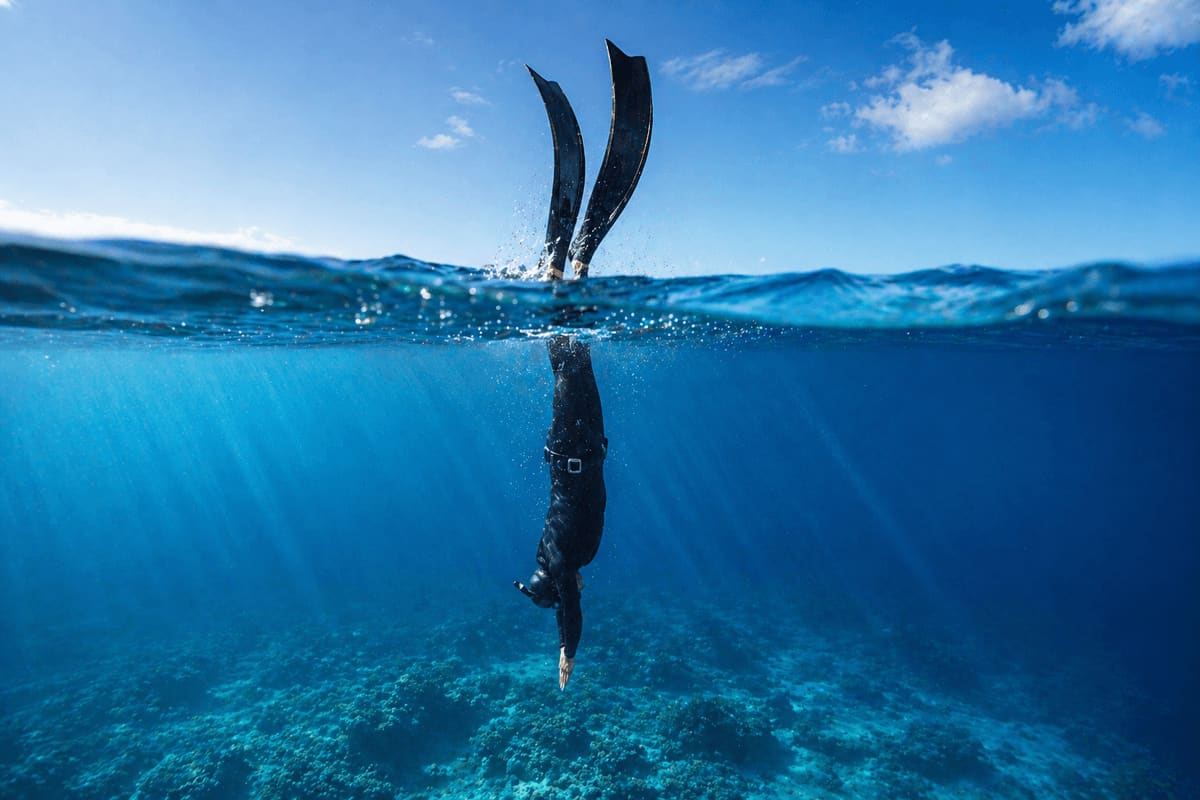
Spearfishing is a way of hunting, and freediving is how most spearfishers get underwater. A breath-hold spearfisher uses the same breathe-up, duck dive and equalization as any freediver, then spends the dive looking for a fish instead of chasing a depth. Florida and California both define it as fishing from in the water: Florida as taking saltwater fish with a spear, gig or lance by a person swimming at or below the surface, California as taking fish by spear or by hand while in the water.
Scuba is legal for spearfishing in some places and banned in others. California's regulations let divers use skin or scuba gear to spear most finfish. West Hawaii bans scuba spearfishing along the west coast of the Big Island, and the Bahamas bans scuba and air compressors for fishing. DAN's spearfishing guidance puts the trade plainly: freedivers make no sound or bubbles while stalking a fish, but their carbon dioxide tolerance limits their time at depth.
If breath-hold diving itself is new to you, start with what freediving is and how its disciplines work. This page assumes you want to hunt and covers what changes when you do.
Which freediving skills carry over to spearfishing
All of the core freediving skills carry over, because the physiology of a breath-hold does not change when you carry a gun. What changes is the pressure to cut corners, and each skill below is one a hunter is tempted to rush.
- Breathe-up
- Slow, relaxed breathing before the dive. PADI's freediver safe diving practices say to extend a breath-hold with relaxation, not hyperventilation. Hyperventilating lowers carbon dioxide and delays the urge to breathe, which is what lets a hunter stay down past the point of safety.
- Duck dive
- A clean, quiet entry saves oxygen and avoids the splashing fins that send fish away before you reach the bottom.
- Equalization
- Frenzel or hands-free equalization lets you descend without stopping. With a gun in one hand, you have only the other free for your nose, so a reliable technique matters more.
- Finning
- Long, slow strokes from the hip. A long blade moves you further per kick, costing less oxygen and making less noise near fish.
- Weighting
- DAN's 2019 spearfishing safety notice says to weight yourself to be neutrally buoyant at 30ft (9m), and names overweighting as one of the top causes of blackout drownings.
- Recovery breathing
- Hook breaths the moment you surface. On a hunt you often surface tired, sometimes with a fish on the line, so the habit has to be automatic.
- Rescue
- Freediving courses teach how to bring a blacked-out diver to the surface and get them breathing. A spearfishing buddy who cannot do this is company, not safety.
How spearfishing changes the dive pattern
A training freediver makes a few planned dives on a line to a set depth. A spearfisher makes many repeated dives with no line, often shallower, and spends much of each one still on the bottom. The goal moves from reaching a target to staying quiet near fish.
Spearfishers borrow European names for the main hunting styles, and each is a different way of spending a breath-hold near the bottom.
- Aspetto
- Italian for waiting. You descend quietly, settle near rock or open sand, and stay still while curious fish come to check you out. The wait is open-ended, which is what makes it easy to overstay.
- Agachon
- A static ambush like aspetto, with more emphasis on hiding. You lie flat on the bottom, behind a rock or in a dip in the reef, and keep fins, gun and weight belt from scraping.
- Agguato
- The moving ambush. You glide along the bottom using ledges, rocks and shadows as cover to close on a fish that has not seen you.
All of these reward stillness, and stillness is what makes them risky. A still diver uses less oxygen than a finning one, but a long wait adds time to a dive that still has an ascent to come, and the end of the ascent is where blackouts happen.
Why spearfishing features so heavily in breath-hold deaths
Spearfishers make up a large share of breath-hold deaths in the best national data available, and the research singles out one recurring cause among younger breath-hold divers: drowning after a blackout from an extended breath-hold without close supervision. The clearest figures come from Australia and New Zealand, where researchers have reviewed coronial records over long periods.
John Lippmann's 2025 review identified 317 snorkelling and breath-hold diving deaths in Australia from 2000 to 2021. Sixty-two victims (20%) were spearfishing. Most of the rest were sightseeing snorkellers, many of them older people with heart conditions. The younger victims were generally breath-hold divers involved in spearfishing, and up to 34 deaths followed apnoeic hypoxia, the loss of consciousness that comes from holding a breath too long. The review's advice to breath-hold divers: do not push your limits without close monitoring by a capable rescuer.
US figures are harder to pin down. DAN's first review of its breath-hold incident data, 145 cases from 1994 to 2004, recorded the victim's activity in only 67 percent of them, so treat any single US percentage for spearfishing deaths with caution.
"The divers are usually overexerted, overweighted, and undersupervised."
The specific risks of hunting on a breath hold
Most spearfishing deaths trace back to a short list of situations, and each is a freediving risk that the hunt makes worse.
- Diving alone
- A recurring factor in both national reviews. DAN's freediving guidance calls diving alone or with an untrained buddy unacceptable, and says freedivers need eyes on each other on every dive, close enough to intervene.
- The extra seconds
- A fish appears late in a planned dive and you stay for the shot. The breath-hold was already budgeted, so the shot, the fight and an ascent with a fish on the line all come out of the reserve.
- Task loading
- Gun, shaft line, float line, fish, current and buddy all compete for attention. DAN's spearfishing guidance notes that when both divers are fishing, it is easy to fixate on a target, ignore your buddy and drift apart.
- Repetitive dives on short rests
- DAN's 2019 notice warns that repetitive freediving can be exhausting and can contribute to a blackout.
- Entanglement
- Shaft line, float line, kelp and discarded fishing line can catch a diver who has no air in reserve to work free. DAN's guidance is to act as soon as a speared fish starts circling you, before the shaft line wraps you.
- Boat traffic
- A boat driver cannot see a diver below the surface. A float with a dive flag is the only warning.
- Predators
- In the Australian review, 9 of the 12 snorkellers killed by sharks or crocodiles were spearfishing. DAN's advice is to end the dive and move if sharks become very interested in your fishing.
Blackout sits behind most of that list. The guide to shallow water blackout walks through the physiology step by step, explains why warning signs are unreliable, and covers why spearfishers sit high on the list of divers at risk.
The one up, one down rule and surface intervals
One up, one down means one diver is always at the surface watching while the other dives, and the roles swap only after the diver who just surfaced has fully recovered. PADI lists it among its standard safe diving practices for freedivers, next to two rules that make it work: recover for at least three times the duration of your breath-hold before the next dive, and do not start a descent until your buddy has completed recovery from theirs.
The watch matters most at the end of the dive. DAN's freediving safety guidance states that 99 percent of blackouts happen at the surface or within 16ft (5m) of it, and PADI tells freedivers to have their buddy escort them over the final part of an ascent from depth. The freediving buddy system page covers the surface buddy's job and the rescue sequence in more detail.
One up, one down on a spearfishing day
- 01 —Agree the plan before you get in: depth range, roughly how long each of you expects to stay down, and what the watcher does if a dive runs long.
- 02 —Carry one gun between you. DAN's spearfishing guidance says only one person in each buddy team should carry a spearing device while the other acts as stringer, swapping at a set time or between dives.
- 03 —The watcher stays at the surface above the diver: not hunting, not loading a gun, not handling fish. If both of you hunt at once, nobody is watching.
- 04 —The diver surfaces, takes recovery breaths and signals OK, and the watcher keeps watching through the recovery.
- 05 —Swap only after full recovery, and rest at least three times the last breath-hold. A 90 second dive earns at least 4.5 minutes at the surface.
- 06 —After a blackout or loss of motor control, the day is over. DAN's blackout guidance is to stay out of the water for at least 24 hours.
Spearfishing gear vs freediving gear
Most of the kit is the same, but spearfishing shifts the priorities toward concealment, toughness and surface safety, and adds a spearing device and a flagged float.
The comparison of spearfishing fins by blade material covers fiberglass against carbon and how to match blade stiffness to your legs.
Weighting is the gear decision most tied to blackout. DAN's 2019 notice says to be neutral at 30ft (9m), and DAN's freediving guidance says to weight yourself so that a blacked-out diver ends up at the surface. A rubber spearfishing weight belt with a quick release is the usual way to carry that lead.
Choosing a spearing device
Spearing devices come in two families. Hand spears, meaning pole spears and Hawaiian slings, are powered by a loop of surgical tubing and work only at close range. Spearguns reach further and come in two types: a band gun uses rubber tubing stretched from the muzzle to tabs on the shaft, and a pneumatic gun uses an internal piston driven by compressed air.
Length is the main choice, and visibility should set it. A longer gun shoots further but is slower to swing and awkward in holes and kelp; a shorter gun is easier to load and aim but has less range. DAN adds the safety side: if the spear can travel beyond the distance you can see, you may hit something or someone you never saw. Choose for the water you dive most, not the clearest day of the year.
- Enter the water with the gun unloaded, and keep your trigger finger outside the guard until you shoot.
- Never point the muzzle or spear tip at anything you do not intend to shoot, loaded or not.
- Unload before handing the gun to the boat, and pass it butt first.
- Keep a bleeding-control kit and a tourniquet on the boat, with a crew that knows how to use them.
Florida spearfishing rules: license, closed areas and dive flags
In Florida you need a saltwater fishing license to spearfish unless you are exempt, and the Fish and Wildlife Conservation Commission (FWC) closes several kinds of water to spearing statewide. Florida Statute 379.354 sets the base license fees: $15.50 for a resident annual license, and for nonresidents $15.50 for 3 days, $28.50 for 7 days or $45.50 for a year, as of October 2026. Children under 16 and Florida residents 65 or older with proof of age and residency are exempt.
The closed areas and gear rules below come from FWC rule 68B-20.003, except the Keys row, which is Florida Statute 379.2425.
Some species cannot be speared at all. FWC rule 68B-20.005 lists billfish, sharks, tarpon, bonefish, snook, red drum, spotted seatrout, weakfish, pompano, African pompano, permit, tripletail, sturgeon, Nassau grouper, goliath grouper (listed under its old name, jewfish), spotted eagle rays and manta rays, plus whole families of reef fish including parrotfish, angelfish, butterflyfish, surgeonfish and puffers.
Dive flag distances
Florida Statute 327.331 sets the dive flag rules. The flag must carry the divers-down symbol and be at least 12x12 inches (30x30cm) when flown from a buoy in the water, or 20x24 inches (51x61cm) when flown from a boat. Divers must make reasonable efforts to stay within 100ft (30m) of the flag in rivers, inlets and navigation channels, and within 300ft (91m) in other waters. Boats must keep the same distances or slow to the minimum speed that keeps steerage, and the flag may be flown only while divers are in the water.
That makes the float a legal item as well as a safety one. When you compare freediving buoys and floats, check that the flag mount takes a flag of at least 12x12 inches (30x30cm), and run a float line long enough for the depth you hunt so the flag stays close to you.
California spearfishing rules: license, species and MPAs
Anyone 16 or older needs a California sport fishing license to spearfish. CDFW lists 2026 prices of $64.54 for a resident annual license, $174.14 for a nonresident annual license, $21.09 for one day, $32.40 for two days and $64.54 for a nonresident 10-day license. Annual licenses run 365 days from purchase. South of Point Arguello, an annual license also needs the $7.30 Ocean Enhancement Validation; one- and two-day licenses do not. Prices are as of October 2026 and change each year. While diving, you may keep the license on the boat, or within 500 yards (457m) of shore if you dive from the beach.
- Species you cannot spear
- Section 28.90 of CDFW's ocean regulations allows spearfishing for finfish other than giant (black) sea bass, garibaldi, gulf grouper, broomtail grouper, trout, salmon and broadbill swordfish.
- Stream mouths
- North of Ventura County, you may not possess or use a spear within 100 yards (91m) of the mouth of any stream in ocean waters.
- Scuba
- Section 1.76 defines spearfishing to include divers using scuba or other underwater breathing gear, and section 28.90 allows skin or scuba gear, so scuba spearfishing is legal in California ocean waters outside closed areas.
- Abalone
- All ocean waters are closed to the take of abalone under section 29.15, with or without a license.
- No catch and release
- A speared fish cannot be released, so identify the species and check its size limit before you shoot.
Marine protected areas
California's MPA network is the rule most likely to catch out a new spearfisher. CDFW's statistics list 124 protected areas (119 marine protected areas and 5 state marine recreational management areas) plus 14 special closures, covering 852.02 square miles (2,207 sq km), or 16.12% of state waters. A state marine reserve bans all take. A state marine conservation area allows some take, and the details differ site by site. Diving itself is allowed unless a site says otherwise.
You may swim through an MPA with your gear and your catch, but only with the gun unloaded, not in your hand, and while you stay at the surface. CDFW states that you are responsible for knowing whether you are inside an MPA, and not every boundary is buoyed, so check the interactive MPA map before each dive. The guide to freediving in California covers sites, water temperatures and courses along the coast.
Hawaii, the Bahamas and checking local rules
Hawaii and the Bahamas both restrict how you can spear, and both make a breath hold the only legal option in at least part of their waters.
Hawaii
The West Hawaii Regional Fishery Management Area runs along the west coast of the Big Island from Ka Lae (South Point) to Upolu Point. Within it, Hawaii's Division of Aquatic Resources prohibits scuba spearfishing, and also possessing scuba gear together with a spear or with speared fish (HAR 13-60.4). Since May 2, 2024, nonresidents also need a marine recreational fishing license: $20 for one day, $40 for seven days or $70 for a year as of October 2026, with nonresidents under 15 and active-duty military and their families exempt.
The Bahamas
Visiting sportfishers in the Bahamas may spear only with permission endorsed in writing on their sportfishing permit, and only with a Hawaiian sling or pole spear. Spearguns are not allowed, and neither is scuba or an air compressor for fishing. Spearfishing is banned within 1 mile (1.6km) of the coast of New Providence and the southern coast of Freeport, Grand Bahama, and within 200 yards (183m) of the coast of any Family Island. These rules come from the Bahamas Ministry of Tourism's 2020 sport fishing regulations guide, so confirm them with the Department of Marine Resources before you travel.
How to start spearfishing safely as a freediver
Learn to freedive first, then learn to hunt. Spearfishing instruction assumes you already have breath-hold, equalization and rescue skills, and Freediving Instructors International (FII) requires a Level 1 Freediver card or equivalent before you can take its Spearfishing course.
- 01 —Take an entry-level freediving course. AIDA 2, SSI Level 1, PADI Freediver, Molchanovs Wave 1 and FII Level 1 all teach breathe-up, duck dives, equalization, weighting and how to rescue a blacked-out buddy.
- 02 —Practice in a pool and in shallow, calm water: weighting, duck dives and still waits on the bottom, with your buddy close.
- 03 —Take spearfishing-specific instruction. FII's Spearfishing course runs about five hours in the classroom and three in confined water, and is open to divers 16 or older.
- 04 —Learn the rules for your water before you buy a gun: license, protected species, size limits and closed areas.
- 05 —Start with a pole spear or short gun in shallow water you already know, with one gun per buddy pair.
- 06 —Add depth slowly, and keep surface intervals at three times your breath-hold even when fish are around.
Ask any instructor what rescue training the course includes and whether they hold a freediving instructor rating. A scuba rating does not cover breath-hold rescue, which is the skill your buddy is most likely to need on a spearfishing day.