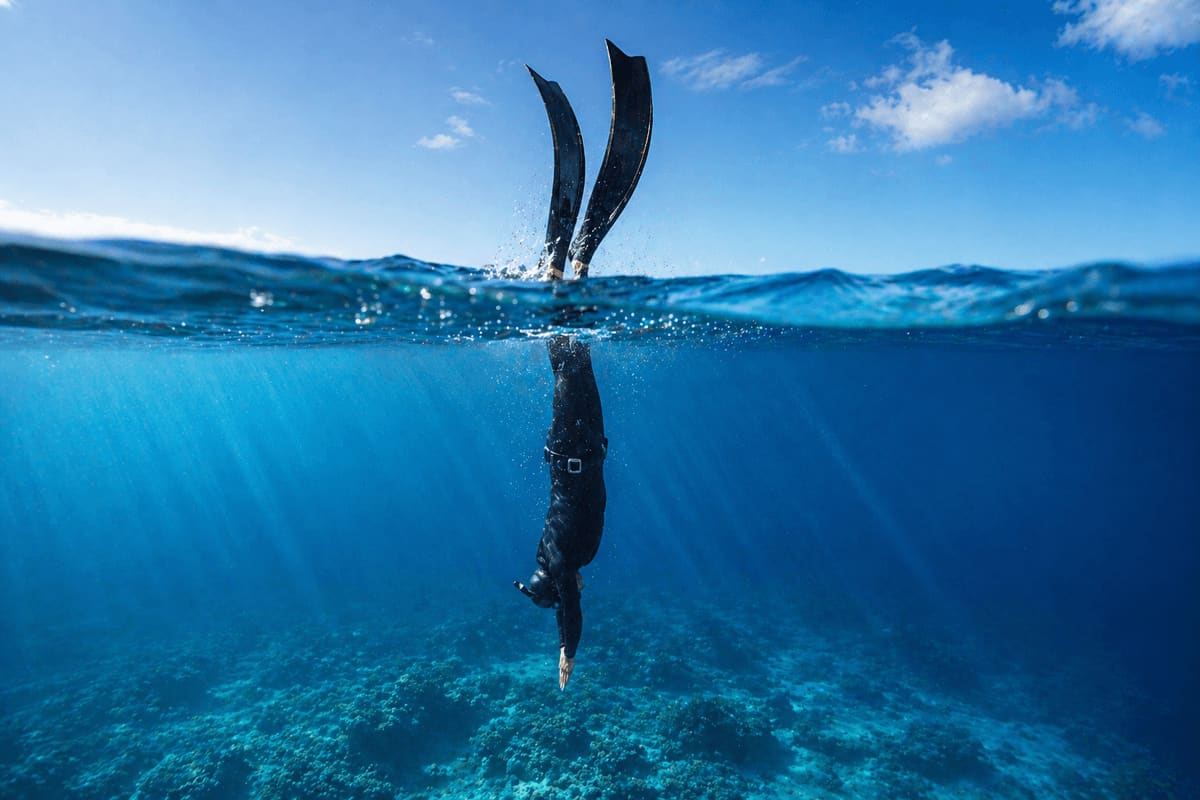

Safety First
Never freedive alone. Dive with a trained buddy who watches every dive, use a flagged buoy away from boat lanes, and train with certified instructors. In the Philippines, dial 911 for any emergency, and know before you travel that the Panglao hyperbaric chamber was not yet operating as of August 2026.
Why Panglao became a freediving hub
Panglao became a freediving hub because very deep water sits within a swim or a few minutes by boat of its north coast, the sea stays warm all year, and full-time schools have built pools, line setups and boat crews around that depth. The island lies off Bohol in the Central Visayas, and most depth training happens on its north side, at Napaling and Doljo.
The wider guide to freediving in the Philippines gives Panglao one section next to Dauin and Batangas. This page goes further: which site does what, what the schools charge in October 2026, how the two monsoons and the typhoon season change conditions, what the sea temperature does month by month, and what the island lacks in emergency care.
Farther along the north side, Freedive SuperHOME on Doljo Beach runs buoy training to 89m (292ft) and platform sessions below that, and its site says the open water there drops past 300m (984ft). In July 2026 the 10th AIDA Asian Freediving Cup ran for nine days off SuperHOME's Y-260 platform, with 93 athletes from 23 countries, according to the Molchanovs team report. If you are weighing Panglao against the Red Sea, the guide to freediving in Dahab covers that alternative.
Visibility figures vary by source and season. Freedive Academy Panglao advertises 30-40m (98-131ft). A Deeper Blue review published in June 2025, covering a training block at Doljo from late 2023, recorded 15m (49ft) at worst in the first days, 20m (66ft) or better after that, and about 35m (115ft) on the best days.
Panglao freediving sites at a glance
Freediving on Panglao runs from two north coast training bases, Napaling and Doljo, with boat trips to Balicasag and Pamilacan and the Alona Beach strip on the south coast as the tourist hub. The table sets out how each site is reached and what depth the published sources give for it.
The boat times come from The Scuba Tribe, a dive center in Danao, and the plane wreck depth from Blue Freedom Apnea. Dive directories disagree on the depth of the Alona reef, so no figure is given here. Ask your school which site it plans to use for each session and why: the answer depends on the wind, the current and your level.
Napaling and the north coast: depth from the shore
Napaling is Panglao's main shore-entry training site, on the north coast in barangay Tangnan. Freedive Academy Panglao, on Napaling Drive, says it sits 300m (980ft) from the ocean, above a coral wall with a large drop-off only 8m (26ft) from shore. From that entry it lists fixed lines at 50m, 80m and 130m (164ft, 262ft and 427ft), which means a beginner and a deep athlete can train from the same beach on the same morning without a boat.
The site is also known for its sardines. A Molchanovs guide to Philippine freediving, published in May 2025, describes Napaling's shallow reef and cliffs as home to big sardine schools and a crack in the reef that is a favorite photo spot.
Napaling charges an entrance fee. The Freedive Academy beginner course sold through Panglao Tours lists the Napaling Reef entrance fee, local taxes and environmental and snorkeling fees as included. If you train independently, budget for the fee at the entry and keep the receipt.
Danao and the monsoon rule
Danao is home to The Scuba Tribe and other dive operators. A 2021 profile of the island's freediving scene by the gear brand Alchemy gives a simple seasonal rule: in the northeast monsoon, dive Danao; in the southwest monsoon, move to Doljo. Treat that as a starting point and let your instructor make the call each day.
- Ask whether the session is a shore entry or a boat dive, and what time it starts. Freedive Academy's reseller listing gives an 8am meeting time.
- Ask which line depth you will use. Beginner courses target 12-20m (39-66ft); the deeper fixed lines are for training.
Doljo and deep training: buoys, platform and prices
Doljo, on Panglao's north side, is where the island's competition platform sits. Freedive SuperHOME, which describes itself as located on Doljo Beach, offers autonomous training to divers certified Molchanovs Wave 3, AIDA 4 or higher. Drift sessions on a buoy are capped at 89m (292ft) for safety, and deeper dives move to a platform, with a counter ballast system for 100m (328ft) and beyond.
These are the rates listed on SuperHOME's training page as of October 2026, converted at about PHP 63 to the US dollar. The page adds that after 15 sessions in one calendar month, the rest of that month's sessions are free, and in-house guests get 15% off. Its courses page lists AIDA 1 to 4 and Molchanovs Wave 1 to 3, with prices on request.
The Deeper Blue review of SuperHOME describes how a session works. You book a morning or afternoon slot the day before, and the scheduler pairs solo divers with others training to similar depths. Boats run 5-10 minutes out to the buoys and about 5 minutes to the platform, the captains set and pull the lines, and every boat carries emergency and decompression oxygen. Cancelling before 8am costs nothing, and the scheduler then reshuffles your buddies.
Balicasag, Pamilacan, Alona and Virgin Island: boat days and fees
Balicasag Island, a marine sanctuary about 10km (6mi) from Panglao, is a boat trip for reef and turtle dives rather than line training. The Scuba Tribe puts Balicasag about 30 minutes by boat from its base in Danao and says scuba permits there are limited to 150 divers a day. PADI's dive site listing gives a maximum depth of 30m (98ft) and lists barracuda, jackfish and green sea turtles. A Molchanovs guide adds that jackfish schools are not always present.
Panglao collects environmental user fees in its marine protected areas. Municipal Ordinance 12 of 2014 started the charges for diving and snorkeling, including at Balicasag, and Ordinance 2 of 2017 raised the snorkeling rate to PHP 150 at Balicasag and PHP 100 at other Panglao snorkeling areas, according to Rappler's 2018 report on how the money is spent. That report counted 44,000 divers registered at five Balicasag dive spots in 2017.
- Balicasag snorkeling fee
- PHP 150 (about USD 2.40) per person under Ordinance 2 of 2017, as reported in 2018. Ask whether freediving is charged at the snorkeling or the diving rate.
- Other Panglao snorkeling areas
- PHP 100 (about USD 1.60) per person under the same ordinance.
- Balicasag scuba fees
- PHP 250 per diver per day plus PHP 300 per boat per day for mooring, on a Panglao dive center price list valid from October 2016.
- Course prices
- Freedive Academy Panglao states its recreational course prices include environmental and snorkeling fees.
These are the most recent figures this guide could find in a published ordinance report or operator list, and rates may have risen since. Ask your school whether its trip price includes them, and ask for an official receipt for anything you pay directly.
Pamilacan, Alona Beach and Virgin Island
Pamilacan Island is about an hour by boat from Danao, per The Scuba Tribe, and is known for dolphin watching and schools of barracuda. Alona Beach on the south coast is the island's busiest area and a departure point for scuba and island-tour boats. In August 2026 the Bohol governor and the national tourism infrastructure agency, TIEZA, inspected a floating dock at Alona built to give those boats safer access; before it, boats ran straight toward the shoreline. The shallow plane wreck that Blue Freedom Apnea uses for fun dives sits at about 6-8m (20-26ft).
Virgin Island, also called Puntod Island, was closed in September 2024 after authorities found coral vandalism and weak waste controls. It reopened in early February 2026 under the Bohol provincial government, working with the environment department and the Panglao local government, with a ticketing booth and visitor limits. Snorkeling at its Estaca site had been linked to reef damage, so expect rules on where you may swim.
Panglao freediving schools and course prices (October 2026)
Three dedicated freediving schools on Panglao publish courses on their own sites and show activity in 2026: Freedive Academy Panglao in Tangnan, Freedive SuperHOME at Doljo and Blue Freedom Apnea. Between them they teach AIDA, Molchanovs and SSI; none of the three lists the PADI Freediver course. The comparison of the best freediving certification explains how those agencies line up.
Of the three, Freedive Academy Panglao is the one that publishes a full price list. It sets its prices in US dollars and converts to pesos at the daily rate. Recreational prices include certification fees, equipment rental, facility use, local taxes and environmental and snorkeling fees, but not the 12% VAT. The school runs a private two-lane 25m pool with a shallow area for static training.
The same beginner course is sold in pesos by Panglao Tours at PHP 18,500 (about USD 295) plus VAT, described as two course days with a bonus open water session on day three and groups of two or three students. Peso conversions on this page use about PHP 63 to the dollar, the rate on October 8, 2026. All prices change, so confirm the figure and what it includes before you pay a deposit. For how course fees fit the full cost of the sport, see the breakdown of what freediving costs.
What each level asks of you
Freedive SuperHOME's course page sets out the open water targets clearly. AIDA 2 asks for 12-20m (39-66ft), AIDA 3 for 24-30m (79-98ft) and AIDA 4 for 32-38m (105-125ft). Molchanovs Wave 1 targets 12-20m over three days, Wave 2 24-30m over four days, and Wave 3 34-40m (112-131ft) over five days. Each level also adds rescue drills from progressively deeper water, from 6-10m (20-33ft) at Wave 1 to 20m (66ft) at Wave 3.
Amihan, habagat and typhoons: when to freedive Panglao
Panglao is dived all year, but the two monsoons decide which site the schools use and how wet the trip will be. PAGASA, the Philippine weather service, divides the year into a rainy season from June to November and a dry season from December to May, with a cool dry stretch from December to February and a hot dry stretch from March to May.
- Habagat (southwest monsoon)
- Warm, moist southwest winds with frequent rain and thunderstorms from May to September. The 2021 Alchemy rule of thumb moves training to Doljo in this monsoon.
- Amihan (northeast monsoon)
- Colder, drier northeast winds that follow the habagat; in 2024 PAGASA declared the habagat over on October 7 and announced the shift to amihan in the following weeks. The same rule of thumb favors Danao in this monsoon.
- Typhoons
- PAGASA says typhoons usually form near the Marianas and Caroline Islands and move northwest. Bohol is not out of their reach: Super Typhoon Odette (Rai) knocked out power across the whole province, and the governor declared a state of calamity on December 17, 2021.
The best month depends on what you want from the trip. A Molchanovs guide names December to April as the best time to visit. Freedive SuperHOME runs pool events from November to April and open water competitions from June to September, and the 2026 Asian Freediving Cup ran in July. The Deeper Blue reviewer called May to July the island's best training months and said whitecaps are possible outside them.
- First course: December to May falls in PAGASA's dry season, so fewer days are lost to rain.
- Deep training block: June to September is when SuperHOME runs its open water competitions, with the platform and line setups in full use.
- Any month: check typhoon forecasts in the week before you travel, and build one spare day into the plan for a blown-out sea or a cancelled ferry.
Panglao sea temperature by month and what wetsuit to wear
Panglao's sea is warm all year, averaging 26.6°C (79.9°F) in February, the coldest month, and 29.4°C (84.9°F) in October, the warmest, according to seatemperature.org's monthly averages. The spread between the coolest and warmest month is under 3°C (5°F), so suit choice is about session length more than season.
These are surface averages. A long depth session means many dives and long, still breathe-ups, which cool you down even in 29°C (84°F) water, so a 3mm suit is worth packing for any training block. The site's wetsuit thickness guide explains how thickness changes your buoyancy and how much weight to carry with each suit.
Getting to Panglao: flights, ferries and transfers
You reach Panglao by air from Manila or by fast ferry from Cebu to Tagbilaran, followed by a short drive. The airport is on Panglao itself, which keeps the transfer short.
- Bohol-Panglao International Airport (TAG)
- Opened in November 2018 in Barangay Tawala on Panglao Island, replacing the old Tagbilaran airport, so you land on the island you are diving from.
- From Manila
- Cebu Pacific and PAL Express both fly Manila to Panglao. The flight takes about 1 hour 15 minutes.
- From Cebu
- No scheduled Cebu flights appear in the airport's route list. Take an OceanJet fast craft from Cebu City Pier 1 to Tagbilaran City Port, about two hours, with departures listed from 5:10am to 6:40pm. Schedules change, so check OceanJet before you travel.
- Other routes
- Cebgo flies to Davao, El Nido and Iloilo, Cebu Pacific to Clark and PAL Express to Davao. Jeju Air serves Busan and Seoul Incheon, and Jin Air Seoul Incheon.
- From the US
- Plan on connecting through Manila, or through Seoul on the Korean carriers.
From the airport, a 2021 island guide puts the taxi or tricycle ride to nearby resorts at 5-10 minutes, and the ride from Tagbilaran pier to Panglao at about 20 minutes. Napaling and Doljo are on the north side and Alona on the south, so a scooter or a pre-booked tricycle makes early sessions easier if you stay at Alona. Before you fly, register on the government's eTravel system: it is free, and you may only register within 72 hours before your arrival.
A sample 7-day freediving week on Panglao
This plan assumes a beginner certification with a school on the north coast, a dry season trip and a flight from Manila. It follows the 2-2.5 day course length that Freedive Academy Panglao and Freedive SuperHOME both publish for AIDA 2, keeps sessions in the morning and leaves room for a weather day.
- 01 —Day 1: Fly Manila to Panglao. Check in near Napaling or Doljo, buy pesos, and test your mask and suit with an easy snorkel.
- 02 —Day 2: Course day one. Theory on breath-hold physiology, equalization and blackout, breathing work, then static and dynamic sessions in the pool.
- 03 —Day 3: Course day two. First open water line dives at Napaling, building toward 12-20m (39-66ft), plus buddy and rescue drills.
- 04 —Day 4: Course finish or bonus session. Final depth requirements and the written exam, then certification.
- 05 —Day 5: Boat day to Balicasag for turtles and reef, or a weather day if the wind is up.
- 06 —Day 6: One guided training session with your new buddy (USD 42 at Freedive Academy Panglao), then rest in the afternoon.
- 07 —Day 7: No diving. Fly out, or stay on for a Level 2 course.
Certified divers can swap the course for a training block: Freedive Academy's Level 1 and 2 combo runs six days with one day off for USD 850, and Wave 3 or AIDA 4 holders can book autonomous buoy sessions at Doljo. If you also scuba dive at Balicasag, DAN's guideline for multiple days of no-decompression scuba is a minimum preflight surface interval of 18 hours, so keep the last day dry.
Safety on Panglao: buddies, boats and the nearest chamber
Freediving safety on Panglao starts with one rule: never dive alone. DAN's freediving safety guidance says buddies need eyes on each other on every dive and must be close enough to intervene, and that a lookout on a boat is not enough. On deeper dives the buddy should meet the diver on the way up at about one third of the dive's depth. The freediving buddy system explains the routine in detail.
"99 percent of blackouts happen either at the surface or within 16 feet of it."
That figure is why the last 5m (16ft) of every dive and the first breaths at the surface need your buddy's full attention, even on a shallow course day. At Doljo, the Deeper Blue review describes divers going deep either having three people on their buoy or tying on to another buoy, with boat captains watching every buoy in the session.
Boats and buoys
Alona Beach is where scuba and island-tour boats load, and until the floating dock was built they ran straight to the shore. A skipper cannot see a freediver underwater, so dive from a clearly flagged freediving buoy and line, surface beside it, and keep away from the dock, mooring areas and boat lanes.
- Ask your school what oxygen it carries on the boat and at the shore entry.
- Ask how the school would move an injured diver to a hospital, and how long it takes. The Deeper Blue review puts ACE Medical Center about 30 minutes from SuperHOME.
Blackout, not decompression sickness, is the main risk in freediving, and it is survivable when a trained buddy is right there. Warm water and depth a short swim from the beach make it tempting to push. On unfamiliar lines, stay well inside your certified depth, rest fully between dives, and finish the session when your buddy calls it.