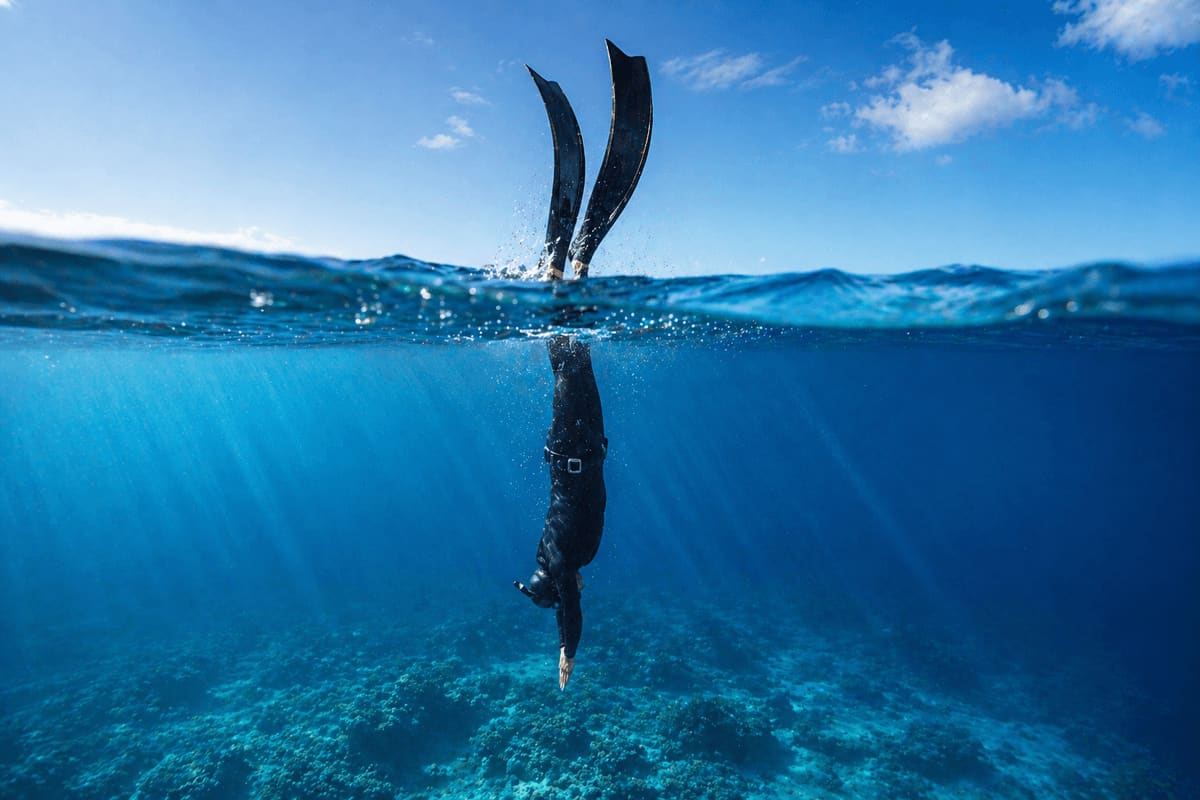

Cold Water Physiology, Why It Is Different
Cold water freediving involves a physiological trade-off that experienced divers learn to use rather than just manage.
- Stronger dive reflex
- The mammalian dive reflex is activated by cold water contact on the face. The colder the water, the stronger the trigeminocardiac reflex, heart rate drops more steeply and peripheral vasoconstriction is more pronounced. Freedivers in 10°C water often report longer holds than in 26°C water, even with identical training.
- Higher metabolic demand
- A cold body burns more oxygen maintaining core temperature. Even with correct wetsuit insulation, some metabolic heat production increases O2 consumption during static holds. This partially offsets the dive reflex benefit.
- Faster cognitive impairment
- Mild hypothermia (core temperature down 1-2°C) reduces cognitive function, reaction time, and judgment, often before the diver feels significantly cold. This is the most underestimated cold water risk.
- Neoprene compression at depth
- A 7mm open cell suit at the surface is fully insulating. At 30m, the neoprene cells are compressed to roughly one-quarter their surface volume, the suit provides minimal thermal insulation at depth. Cold water freediving feels coldest at the bottom of long dives.
Gear Selection for Cold Water
Open cell neoprene is the correct choice for any serious cold water freediving. An open cell suit grips the skin, so less water flushes through it than through a lined surf suit; MAKO, for example, states that open cell suits are about 20% warmer than closed cell suits of the same thickness. Below about 17°C, add a hood, 3mm socks and a pair of freediving gloves as well, because hands and feet chill long before the core does. In Monterey, where the sea averages 12.1-14.5°C (54-58°F) in every month, that full kit is needed year-round; the guide to freediving in California gives monthly averages for Monterey and San Diego.
Two-piece math
A 7mm jacket + 7mm pants create 14mm of neoprene coverage over the core where the two pieces overlap. The integrated hood on most two-piece freediving suits eliminates the neck seal gap, which is responsible for disproportionate heat loss relative to its surface area. A well-fitted 7mm two-piece open cell suit with integrated hood is the maximum practical warmth available before drysuit use.
US Cold Water Freediving Locations
Putting On an Open Cell Wetsuit
Open cell neoprene requires lubrication: the exposed cell interior grips anything it contacts, including dry skin. Without lubrication, the suit tears. The donning process takes 3-5 minutes when practiced correctly.
- Prepare lubricant: diluted hair conditioner (1:10 with water), specialized wetsuit lube, or baby shampoo solution. Avoid Vaseline or petroleum products. They degrade neoprene.
- Wet the interior of the pants thoroughly with the lubricant solution.
- Step in while the interior is wet and slick. Pull up by holding the exterior only, never grip the interior with fingers or nails.
- Work upward slowly. Once over the hips, the pants should sit at the correct waist height.
- Repeat for the jacket. Wet the interior, insert arms first, then pull over the head and torso.
- The integrated hood pulls over the head last, wet the face area of the hood to help it pass over facial contours.
- Once fully on, the lubricant solution drains and the suction grip activates against skin.
Session Management in Cold Water
Cold water sessions require more deliberate management than warm water diving. The physiological factors that extend hold times (stronger dive reflex) also mask fatigue and hypothermia onset.
- Warm up with 3-5 shallow dives (5-10m) before attempting any target depth. Cold tissue equalization is harder and cold muscles are injury-prone.
- Apply the 1:2 surface interval rule: for every 1 minute underwater, spend at least 2 minutes at the surface. Cold water sessions often involve shorter dives but more fatigue per dive.
- End the session before you feel significantly cold, cognitive function impairs before physical coldness becomes acute. Set a time limit before entering the water.
- After exiting, warm up immediately: thermos of warm water, hot shower, or changing into dry warm layers. Post-dive hypothermia can develop after leaving the water.
- Never dive alone in cold water. In addition to standard freediving buddy rules, cold water adds hypothermia as a second solo risk that can incapacitate gradually.