
Convert your lead between salt and fresh water, and set your neutral depth
Start from a setup that already passed a neutral buoyancy test. The calculator only does the parts that physics can answer.
01 Salt and fresh water
Leaving it blank understates the change by about 2.7% of the gear's mass.
02 Neutral depth for your dive
Every result here is a starting point. Confirm with the neutral buoyancy test before diving deeper.
- Sea water 1.025 kg/L and fresh water 1.000 kg/L (The Groundwater Project); lead 11.3 g/cm3 (Royal Society of Chemistry). Coated weights are slightly less dense than bare lead, which makes the real change slightly larger.
- Same suit, gear, breath and test depth in both waters, and that you were truly neutral in the water you tested in. The small pressure difference between the same depth in fresh and salt water is ignored.
- Neutral depth: one third of the planned depth, never shallower than 10 m (one-third rule: PADI and Alchemy; 10 m floor: Alchemy and Molchanovs). Gas volume uses 1 atm per 10 m of sea water and an ideal gas; lab-tested neoprene compressed by a mean 64.3% at about 20 m, against 66.7% for an ideal gas.
- No wetsuit thickness conversion, no body-weight formula, and no kilograms for moving your neutral depth: no source reviewed publishes a rule for any of them.
What Correct Weighting Means
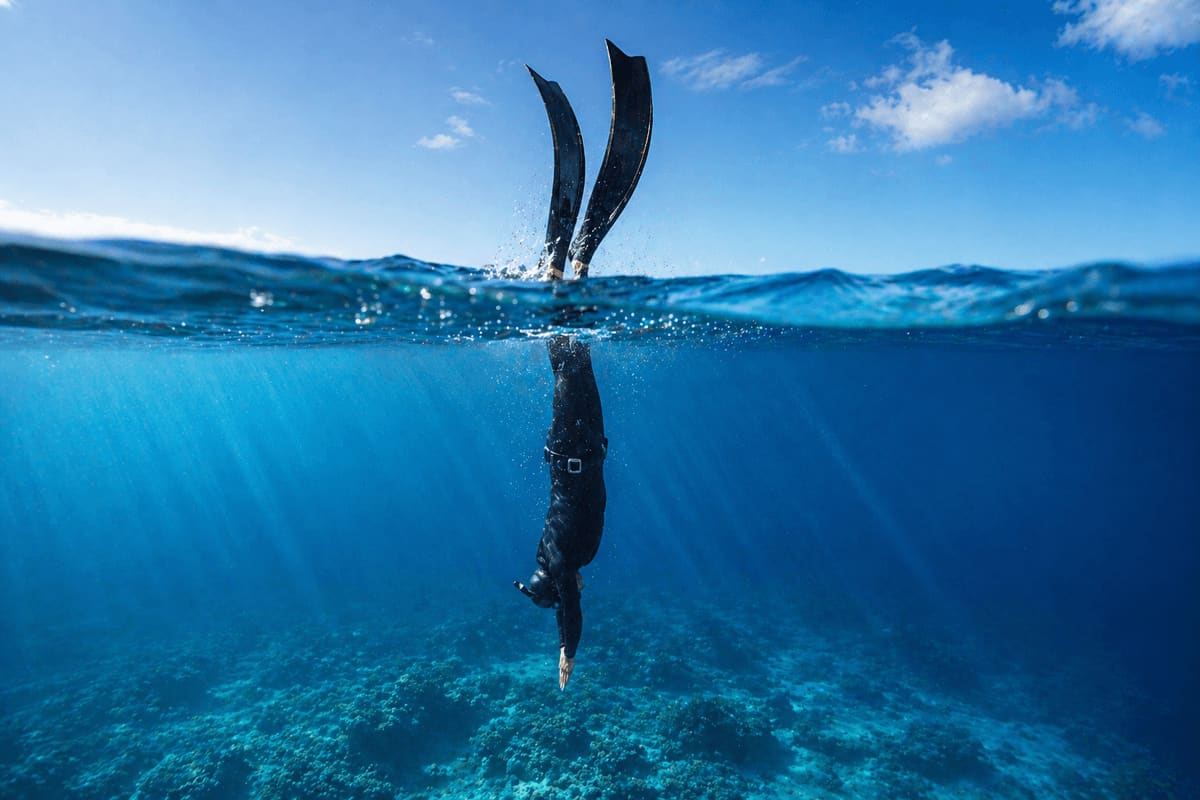
Correct freediving weighting is defined by depth, not by how fast you sink. The target the training agencies describe is a diver who floats at the surface, becomes neutral at a chosen depth, and sinks without kicking below it. SSI puts the typical neutral point for a well-balanced freediver at around 10 to 12 m on deep dives, with the diver negatively buoyant below that depth.
The same lead behaves differently at different depths because of pressure. Water compresses the air in your lungs and the gas sealed in the neoprene of your suit as you descend, so you displace less water and lose lift. PADI's weighting guide describes it this way: the deeper you go, the more compressed the air spaces in your body and wetsuit become, and the faster you sink. Past the neutral point you enter free fall and stop kicking.
- At the surface, after a relaxed exhale, you stay afloat (PADI and Molchanovs both use this check)
- With a maximal breath held at the surface, the water sits around your neck (PADI)
- At your chosen neutral depth you neither rise nor sink when you stop moving
- Below that depth you sink without finning, which is free fall
The calculator above handles the two parts of this that physics and published guidance can answer: how much lead to change when you move between salt and fresh water, and where your neutral depth should sit for a planned dive. Everything else on this page explains how to find your actual number in the water, because no published agency formula replaces the test.
Why Lighter Is the Safer Mistake
Weighting is a safety setting before it is a performance one. In DAN's Alert Diver article on freediving safety, Chris Bustad writes that 99 percent of blackouts happen at the surface or within 16 feet (about 5 m) of it, and that it is optimal to be weighted so that a diver who blacks out still ends up at the surface. PADI's weighting guide gives the same reasoning for being positively buoyant in the last 10 to 5 m of the ascent, where most shallow water blackouts occur.
Overweighting removes that margin. Bustad notes that students and untrained divers often wear so much lead that they have to swim to keep their heads up at the surface even on a peak inhale, and that an overweighted diver who loses consciousness would sink, possibly at an alarming rate. He adds that a good entry with correct weighting makes the descent easier than loading up on lead does. Alchemy's weighting guide is blunter: overweighting is dangerous, and extra lead makes the ascent from a deep dive harder.
None of this replaces a buddy. Weighting decides whether you drift toward the surface after a blackout; a trained buddy is what gets your airway out of the water. The freediving buddy system guide covers how buddies watch a dive, and DAN's article adds that on deeper or longer dives the buddy may need to meet the diver at one third of their depth.
Choosing Your Neutral Depth
There is no single agreed depth. PADI's weighting guide lists three schools of thought, and the other sources reviewed here narrow the range:
The safety reasoning in the previous section makes the shallow end the floor. Alchemy's guide says 10 m should be the minimum, because a shallower neutral point means you are overweighted, and that divers going deeper can set the neutral point deeper and carry less lead. That is the rule the calculator applies: one third of your planned depth, never shallower than 10 m. A deeper neutral point always means less lead and more lift near the surface, which is the direction DAN and PADI favor.
Pool disciplines work differently. In dynamic apnea the aim is to glide level in shallow water, so Alchemy's guide replaces the depth test with a glide test: push off the wall, wait until you have fully stopped, and add weight if you end up floating at the surface.
Starting Points, and Why There Is No Formula
Body-weight formulas and fixed amounts of lead per millimetre of neoprene appear on many websites, and they do not agree with each other. None of the agency material reviewed for this guide (PADI, SSI, Molchanovs and DAN) publishes one. The closest thing to an agency figure is PADI's weighting guide, which gives a starting point for an average-sized person in each suit thickness:
PADI does not say whether these are salt or fresh water figures, does not define an average-sized person, and does not separate open-cell from closed-cell neoprene. Treat them as the weight to bring to your first test, not as your answer. Molchanovs' beginner equipment guide explains why the number is personal: lead compensates for buoyancy that comes from your body composition as well as from your wetsuit. Alchemy's guide adds that muscle sinks, so two divers of the same body weight in the same suit can need different amounts of lead.
Your suit changes the starting point more than anything else you choose. The wetsuit thickness guide covers which thickness suits which water temperature. Whichever suit you pick, the surface check and the 10 m test set the lead, and the result belongs to that suit only.
The Surface Check
Start every weighting session at the surface, next to a float, before any depth test. Molchanovs' beginner guide describes the check in four steps:
- 01 —Float vertically at the surface while holding onto a float.
- 02 —Exhale deeply, without forcing all the air out of your lungs.
- 03 —Hold your breath on that exhale, relax without kicking, and let your hands slide off the float.
- 04 —Check that you are not sinking. Your head may bob under, but you should not keep going down. If you do, grab the float or fin back up, remove some weight, and repeat until you no longer sink.
PADI adds two waterline checks at the full-breath end: with a maximal inhale held, the water should sit around your neck, and with a normal full breath it should reach your chin. SSI's version of the exhale check puts the waterline ideally around the eyebrows. The details differ, but every version agrees on the outcome: after an exhale at the surface, you must stay up.
The surface check only tells you that you are not too heavy at the top. It cannot tell you where you become neutral, because your suit and lungs are at their largest at the surface. That is the job of the depth test.
The 10 m Neutral Buoyancy Test
The depth test is where your real number comes from. Do it on a line, with a buddy, in the water you plan to dive and in the suit you plan to wear. PADI's version has four steps:
- 01 —Take a full breath and kick or pull down the line to 10 m (30 ft), or to the neutral depth you have chosen.
- 02 —Stop, relax, and watch the line or your dive computer.
- 03 —If you neither rise nor sink, you are neutral at that depth.
- 04 —If you rise or sink, return to the surface, change your weight by 1 to 2 lb or kg, and repeat.
Alchemy's guide adds a detail that makes the reading easier: at the test depth, turn head-up, stop moving and count to 10. If you sink, you are too heavy. If you float up, go a little deeper and check again, which shows where your neutral point actually sits.
Change lead in small steps. Molchanovs recommends individual freediving weights of 1 kg or less, spaced evenly on the belt, which also lets you adjust in steps of 1 kg or less instead of guessing between large blocks.
If your pool is not deep enough for a 10 m test, use the surface check and the glide test there, then repeat the 10 m test on your first open water day before diving deeper. The pool training guide covers how to structure those sessions safely.
How Your Suit and Lungs Lose Buoyancy With Depth
Every 10 m of seawater adds about one atmosphere of pressure, and by Boyle's law a gas at constant temperature shrinks as the pressure on it rises. The University of Hawai'i ocean science course gives the reference point: at 10 m the pressure has doubled and air is compressed to half its surface volume. The same arithmetic gives the rest of this table for any gas that behaves like an ideal gas, such as the air in your lungs:
Neoprene is a rubber foam with sealed gas cells, so it does not shrink exactly like free air, but lab data shows it comes close. A 2025 study in Polymers loaded 33 commercial neoprene sheets in 3, 5 and 7 mm thicknesses at pressures equal to depths of up to about 20 m. At 200 kPa, roughly 20 m, the samples compressed by 52.8% to 72.9% of their thickness, a mean of 64.3%, against the ideal-gas figure of 66.7% at that depth. The same study found that even 50 kPa, about 5 m, cut thermal resistance by 21.5% on average, which is the warmth side of the same effect covered in cold water freediving.
Two practical consequences follow. First, the thicker the suit, the more lift it loses on the way down: SSI notes that 5 to 7 mm suits give more buoyancy at the surface but lose it at depth, while 1 to 3 mm suits stay more stable across depths. Second, the lead you need depends on where you want to be neutral. A diver who sets the neutral point shallower than planned carries more lead and is heavier at every depth below it, which is why the neutral depth matters as much as the total.
Compression is also why freediving belts are rubber or silicone. Molchanovs' guide recommends them over the nylon belts used in scuba because they stay tight as the wetsuit compresses with depth.
Suits also change with use. A 2026 follow-up study by the same research group put neoprene samples through 50 immersion cycles at 15 m and found that thickness decreased in most of them. A setup that tested well when the suit was new is worth testing again as the suit ages.
Salt Water vs Fresh Water: How Much Lead to Change
This is the one weighting change that physics answers outright. Seawater with a typical salt content of about 35 g per kg has a density of about 1,025 kg per cubic metre, against about 1,000 for fresh water, according to The Groundwater Project's text on variable-density flow. Fresh water is therefore about 2.4% less dense, it holds you up less, and you need less lead in it. SSI states the same rule: salt water gives more lift, so the ocean needs more weight than a lake or a pool.
The amount follows from Archimedes' principle, which SSI's buoyancy guide gives as an upward force equal to the weight of the water you displace. If you are neutral in one water, your total mass (body, suit, fins, mask and lead) equals the mass of the water you displace. In water of a different density the buoyancy changes in proportion. Lead also displaces a little water, at a density of 11.3 g per cubic centimetre according to the Royal Society of Chemistry, so each kilogram of lead changes your buoyancy by slightly less than a kilogram. Put together:
- Salt to fresh water: remove about 2.7% of your total mass in lead (total mass x 0.0268)
- Fresh to salt water: add about 2.7% of your total mass in lead (total mass x 0.0275)
- The change scales with total mass, so a fixed figure such as 1 kg cannot be right for every diver
Worked example: a diver whose body, suit, fins, mask and lead add up to 80 kg tests neutral at 10 m in the sea, then dives a freshwater lake. 80 x 0.0268 = 2.14, so about 2.1 kg comes off the belt. The same diver moving from a freshwater pool to the sea adds about 2.2 kg. Body mass is most of the total, which is why a heavier diver needs a bigger change than a lighter one.
The limits of the conversion are worth knowing. The densities above are typical values: fresh water density shifts slightly with temperature, and Alchemy's guide notes that salinity differs from sea to sea, so weighting can differ between locations. Brackish water falls between the two figures. If you know the density at your dive site, the calculator accepts a custom value. Either way, the result is the weight to take to the neutral buoyancy test, not a replacement for it.
Belt, Neck Weight, or Both
Where the lead sits changes your body position, not your buoyancy: moving a kilogram from the belt to the neck leaves the total the same. Molchanovs' beginner guide sets out the belt basics: rubber or silicone rather than nylon, stretched tight across the hips so it does not slide when you are head-down, and a Marseille (pin) buckle, which it calls the most reliable quick release. PADI adds that the belt should sit low on the hips so you can breathe fully, and that the quick release lets you or a buddy drop the weight in an emergency. The freediving weight belt comparison covers belts built to those specs.
The weights themselves should be small. Molchanovs recommends pieces of 1 kg or less, spaced evenly, and rubber-coated weights in pools; PADI's guide also prefers small weights so you can fine-tune and spread the load for comfort.
A neck weight moves part of that total toward the head. In Alchemy's guide to choosing one, freediver Xavier Daru gives a typical range of 1 to 2.5 kg for deep diving and says that weight above 2.5 kg belongs on the belt; he describes the benefit as a streamlined, balanced body on the descent. For pool dynamics, Alchemy's weighting guide prefers a neck weight because it keeps as much lead as possible close to the lungs. SSI says neck weights can improve body position, reduce drag and prevent head tilt.
- Belt only
- The simplest setup, with all of the lead on the quick-release buckle that you or a buddy can drop. The natural place to start while you establish your total.
- Belt plus neck weight
- Move weight from the belt to the neck rather than adding it, within Daru's 1 to 2.5 kg range for depth, then repeat the 10 m test.
- Neck weight for pool dynamics
- Alchemy's guide prefers it for dynamic apnea, where the aim is to keep the lead close to the lungs. Test with the glide test, not a depth test.
Re-test after any change in the split. The total may be the same, but the way you hang at your neutral depth and your trim on the line can change.
When to Re-Test Your Weighting
A tested number belongs to one combination of diver, suit and water. Alchemy's guide puts the rule simply: if you change anything, check your buoyancy again. SSI gives the same advice for changing environments. Re-test when any of these change:
- Wetsuit: a different thickness, a different suit of the same thickness, or the same suit after a lot of use
- Water: salt to fresh or the reverse (run the calculator first), or a sea with a different salinity
- Your body: Molchanovs and Alchemy both list body composition as a factor in how you float
- Planned depth: a deeper target can justify a deeper neutral point and less lead
- Anything added that floats or sinks, such as a hood, socks or gloves
- Weight distribution: moving lead between belt and neck
The salt and fresh water switch is the one change that does not need a search from scratch: the calculator gives the change from density alone. It still needs one confirming dive to your neutral depth, because density is the only thing the conversion knows about.
Common Weighting Mistakes
- Adding lead to ease the descent
- DAN's article says a good entry with correct weighting makes descending easier than loading up on lead. Fix the entry instead.
- Weighting from the surface only
- Your suit and lungs are largest at the surface, so a surface check cannot show where you become neutral. SSI lists ignoring wetsuit compression as a cause of unexpected buoyancy shifts at depth.
- Overweighting
- SSI links it to rapid descents and tiring ascents, and DAN warns that an overweighted diver who blacks out sinks.
- Underweighting
- SSI notes that it makes the descent hard and wastes energy early. Add weight gradually until you are neutral at your chosen depth.
- Testing in different gear
- A pool test in a thin suit says little about the sea in a 7 mm suit. Test in the suit and the water you will dive in.
- A fixed salt to fresh figure
- The change is about 2.7% of total mass, so a fixed figure is too much for a light diver and too little for a heavy one.
If the descent is the problem, technique fixes it more safely than lead: the duck dive guide covers the entry. For the rest of the kit that goes with your weights, the freediving starter kit lists what a beginner needs.